

IT & Computer Training Courses
Build practical IT skills from computer fundamentals, hardware and networking to servers, programming, web development, databases, data analytics, cybersecurity, cloud and modern IT operations.
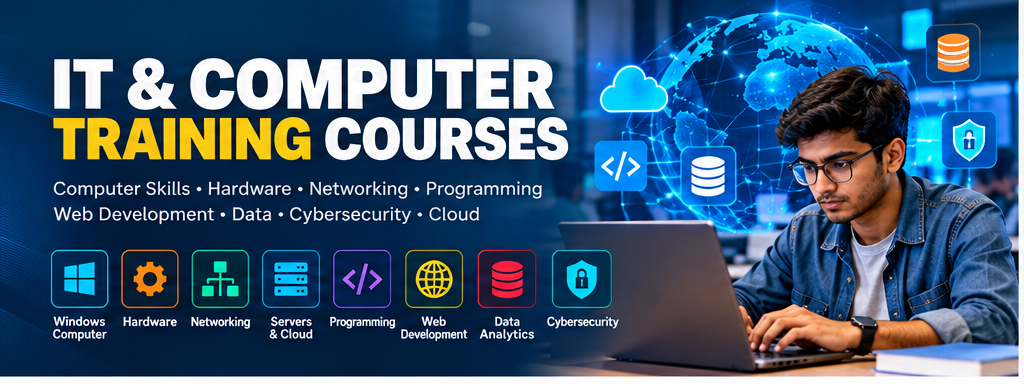
Build Skills From Computer Fundamentals to Professional IT Technologies
The NCVT IT learning pathway is designed to help learners understand how computers, operating systems, networks, software, databases, servers and connected infrastructure work together.
Learn the Technology — Then Use It
IT training should go beyond terminology and demonstrations. Learners should be able to install, configure, program, troubleshoot, secure and manage technology.
Individual courses can be taken for focused skill development or combined into a broader IT career pathway.
Learn → Configure → Build → Troubleshoot
Build practical capability through guided exercises, software, hardware, networking and project-oriented learning.
IT Learning Paths by Career Direction
Computer & Digital Skills
Windows, files, applications, internet and workplace computing.
Hardware Technician
Computer components, installation, maintenance and troubleshooting.
Network Engineer
TCP/IP, switches, routers, LAN/WAN, Wi-Fi and network services.
System Administrator
Windows Server, Linux, users, permissions, servers and infrastructure.
Software Developer
Programming, Python, C/C++, Git and application development.
Web Developer
HTML, CSS, JavaScript, backend, databases and web applications.
Data Analyst
Excel, SQL, dashboards, visualization, Power BI and Python.
Cybersecurity / Cloud
Security, servers, Linux, cloud, virtualization and IT operations.
Computer Fundamentals & Digital Skills
Develop the operating-system, computer and workplace skills required before progressing into specialized IT technologies.
Windows Fundamentals
Windows desktop, Start menu, taskbar, File Explorer, files, folders, settings, Wi-Fi, security and troubleshooting.
Request Windows Training →Computer Fundamentals
Hardware basics, operating systems, keyboard, files, internet, applications, storage and digital literacy.
Request Course Details →Office & Workplace Computing
Documents, spreadsheets, presentations, email, cloud files and practical workplace computer skills.
Request Program Details →Computer Hardware & Networking
Learn how computers, local networks, connectivity and IT infrastructure are installed, configured and troubleshot.
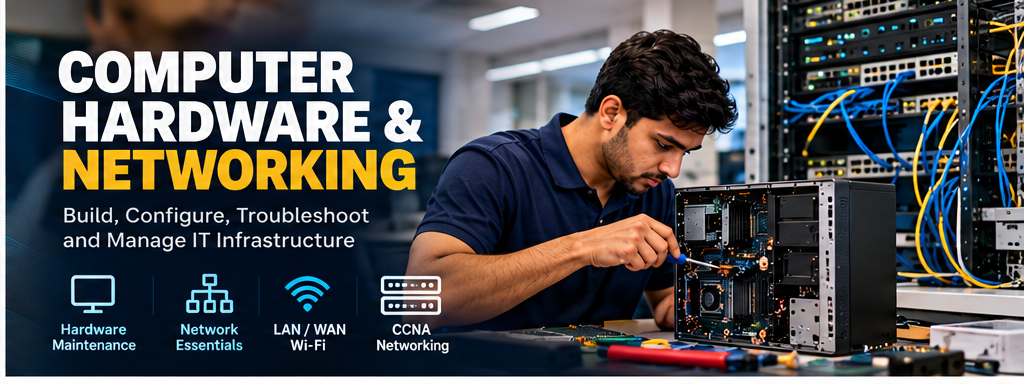
Understand Computers & Networks From the Inside Out
Build practical knowledge of computer components, operating systems, network devices, IP addressing, connectivity and troubleshooting.
Computer Hardware & Maintenance
Motherboards, CPUs, RAM, storage, power supplies, peripherals, assembly, installation and troubleshooting.
Request Hardware Training →Network Essentials
Network architecture, Ethernet, IPv4, subnetting, switches, routers, Wi-Fi and connectivity testing.
Request Networking Training →CCNA Networking
Routing, switching, IPv4/IPv6, VLAN concepts, network services, security fundamentals and enterprise networks.
Request CCNA Training →Programming, Web Development & Data
Build coding, application, database and analytical skills for modern software and digital careers.
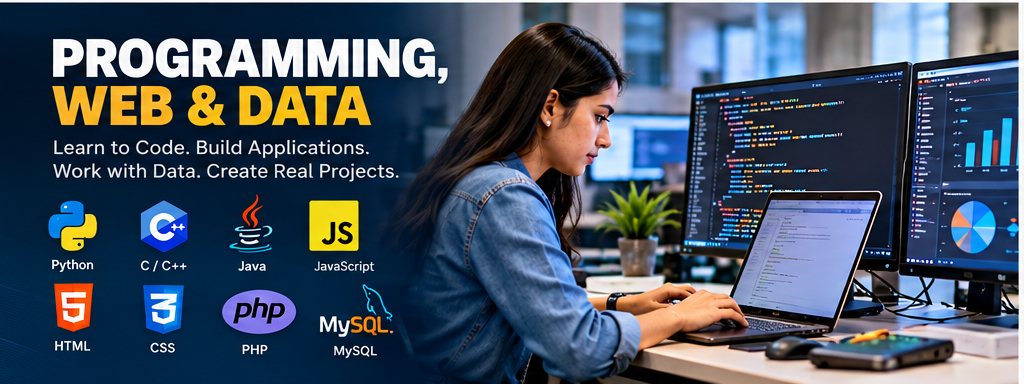
Python Programming
Variables, conditions, loops, functions, collections, files, object-oriented programming and practical applications.
Request Python Training →C & C++ Programming
Programming fundamentals, functions, arrays, pointers, structures, classes, objects and problem solving.
Request C / C++ Training →Java Programming
Java syntax, classes, objects, inheritance, collections, exceptions, database connectivity and application concepts.
Request Java Training →HTML, CSS & JavaScript
Responsive web pages, HTML, CSS, JavaScript, layouts, forms, DOM and frontend development.
Request Web Training →Full Stack Web Development
Frontend, backend, APIs, authentication, databases, application architecture and deployment.
Request Full Stack Details →WordPress & CMS Development
WordPress, themes, plugins, page building, hosting, website management and SEO fundamentals.
Request WordPress Training →SQL & Database Fundamentals
Tables, queries, relationships, filtering, joins, normalization and relational database concepts.
Request SQL Training →Data Analytics & Power BI
Excel, SQL, data preparation, analysis, dashboards, visualization, reporting and Power BI.
Request Analytics Training →Data Science Fundamentals
Python, statistics, data preparation, visualization, machine-learning concepts and analytical projects.
Request Data Science Details →Cybersecurity, Cloud, Servers & IT Operations
Develop infrastructure, server, administration and security skills used in modern IT environments.
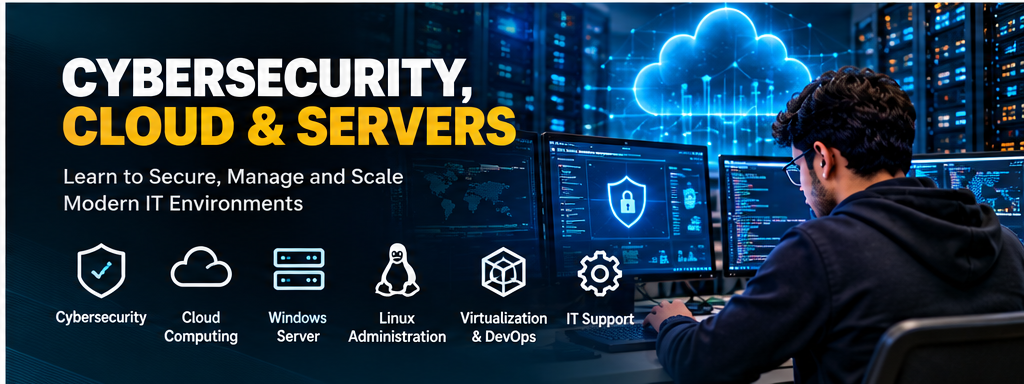
Windows Server Administration
Server installation, users, groups, permissions, Active Directory, DNS, DHCP and administration.
Request Windows Server Training →Linux Administration
Linux installation, shell commands, users, permissions, processes, filesystems, services and networking.
Request Linux Training →Cloud Computing Fundamentals
Cloud architecture, compute, storage, networking, identity, virtual machines, backup and infrastructure concepts.
Request Cloud Training →Cybersecurity Fundamentals
Threats, vulnerabilities, authentication, access control, endpoint protection, network security and security awareness.
Request Cybersecurity Training →IT Support & Help Desk
User support, Windows, software, hardware, printers, network connectivity, troubleshooting and service workflow.
Request IT Support Training →DevOps Fundamentals
Linux, Git, automation, CI/CD concepts, containers, deployment and modern software operations.
Request DevOps Training →Industrial IT, OT & Connected Systems
Combine conventional IT with industrial automation, SCADA, networking, databases and IoT.
Industrial Networking
Ethernet, TCP/IP, PLC networks, Modbus TCP, Profinet, EtherNet/IP and industrial troubleshooting.
Explore Automation Courses →SCADA, OPC & Industrial Data
SCADA connectivity, OPC concepts, SQL, historians, industrial databases and IT/OT integration.
Explore HMI & SCADA →IoT & Connected Systems
Sensors, embedded devices, gateways, networking, MQTT, cloud communication and connected applications.
Explore Embedded & IoT →Build IT Skills in the Right Sequence
Your starting point depends on your existing computer knowledge, education and target career.
Foundation
Computers, Windows, files and digital skills.
Infrastructure
Hardware, networking and operating systems.
Development
Programming, web and databases.
Specialization
Data, security, cloud or DevOps.
Application
Projects, troubleshooting and career skills.
Skills Across the IT Ecosystem
IT Training for Beginners, Students & Professionals
Students & Beginners
- 10th / 12th students
- ITI students
- Diploma students
- Engineering students
- BCA / MCA students
- B.Sc. / M.Sc. students
- Graduates from other disciplines
- Complete computer beginners
Working Professionals
- IT support professionals
- Network technicians
- System administrators
- Software developers
- Automation engineers
- Data professionals
- Technical support engineers
- Professionals moving into IT careers
Career Roles Supported by IT Skills
IT & Computer Training FAQs
Which IT course is suitable for a complete beginner?
Beginners can start with computer and Windows fundamentals before progressing into hardware, networking, programming, web development or another specialization.
Can students from a non-IT background learn IT?
Yes. Learners can begin with computer fundamentals and progress gradually toward a technical specialization.
Does NCVT provide computer hardware and networking training?
The IT learning pathway includes computer hardware, maintenance, network fundamentals, TCP/IP, routing, switching, LAN/WAN and Wi-Fi concepts.
Is programming included in IT courses?
Programming pathways can cover Python, C, C++, Java, web technologies, databases and software-development fundamentals.
Can I learn web development?
Yes. Web-development training can progress from HTML, CSS and JavaScript into backend development, databases, APIs and full-stack applications.
Does NCVT provide data analytics training?
Data-oriented training can include spreadsheets, SQL, data preparation, visualization, dashboards, Power BI and Python-based analytics.
Is cybersecurity included?
Cybersecurity fundamentals include threats, vulnerabilities, authentication, access control, endpoint protection and network-security concepts.
Are server and cloud technologies included?
Server and infrastructure pathways can include Windows Server, Linux, system administration, virtualization, cloud and IT operations.
Does NCVT cover industrial IT?
NCVT's automation ecosystem also connects IT concepts with SCADA, industrial networking, OPC, SQL, historians and IoT technologies.
Start With Computer Skills. Build Toward a Modern IT Career.
Choose from computer fundamentals, hardware, networking, programming, web development, databases, analytics, cybersecurity, servers, cloud and industrial IT.
Get IT Course Guidance →