
Embedded System Courses
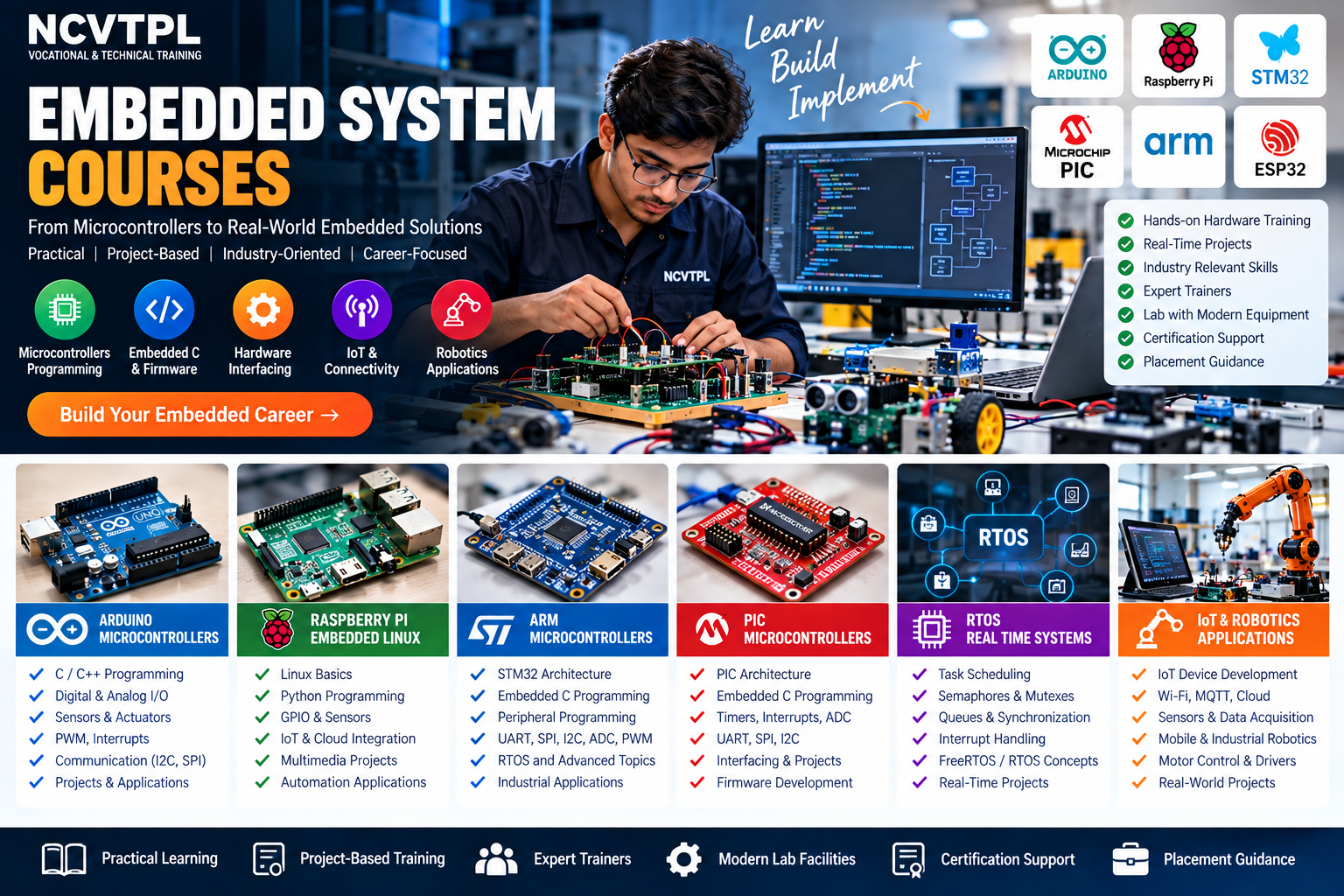
Build professional embedded engineering skills from electronics, Embedded C and microcontrollers to ARM, Raspberry Pi, RTOS, serial communication, CAN, IoT, robotics and industrial embedded applications.
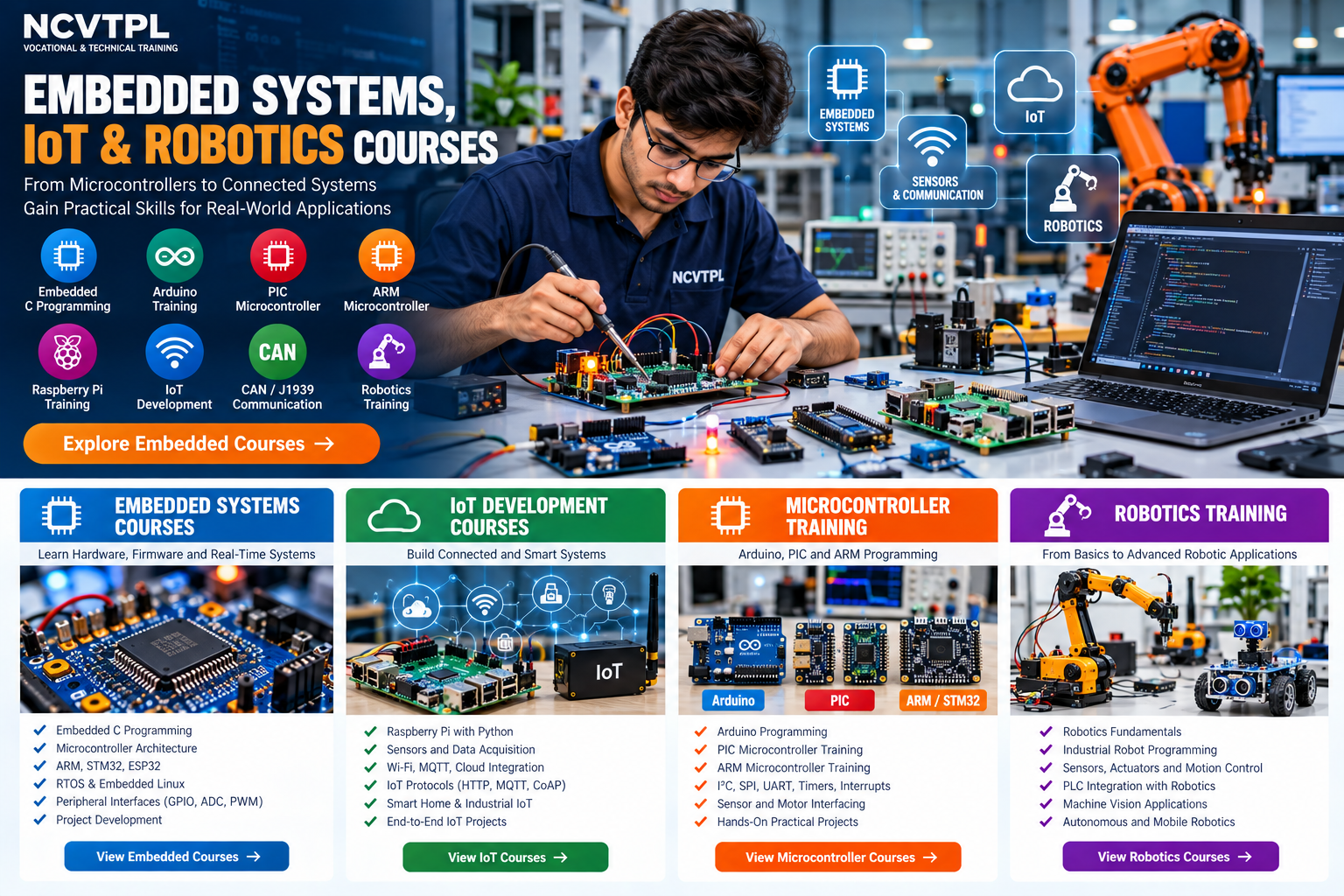
From Electronics & Firmware to Intelligent Connected Systems
Embedded systems combine electronics, computing, firmware, sensors, communication and control to perform dedicated functions inside machines, products, vehicles and intelligent devices.
Hardware + Software + Firmware
NCVT Embedded System Courses connect programming with real hardware. Learners progress from microcontroller architecture and Embedded C into peripherals, sensors, communication, real-time systems, Linux, IoT and robotics.
Individual courses can be taken for focused skill development, while the complete professional pathway connects the technologies into end-to-end embedded engineering.
Learn → Program → Interface → Communicate → Integrate
The emphasis is on understanding how software interacts with hardware and how complete embedded products are designed, tested and troubleshot.
Embedded Technologies You Can Learn
Complete Embedded Systems Engineering Pathway
NCVT Certified Embedded Systems Engineer
A comprehensive path connecting electronics, Embedded C, microcontrollers, firmware, RTOS, Embedded Linux, IoT, CAN/J1939, robotics and advanced embedded technologies.
Explore Complete Program →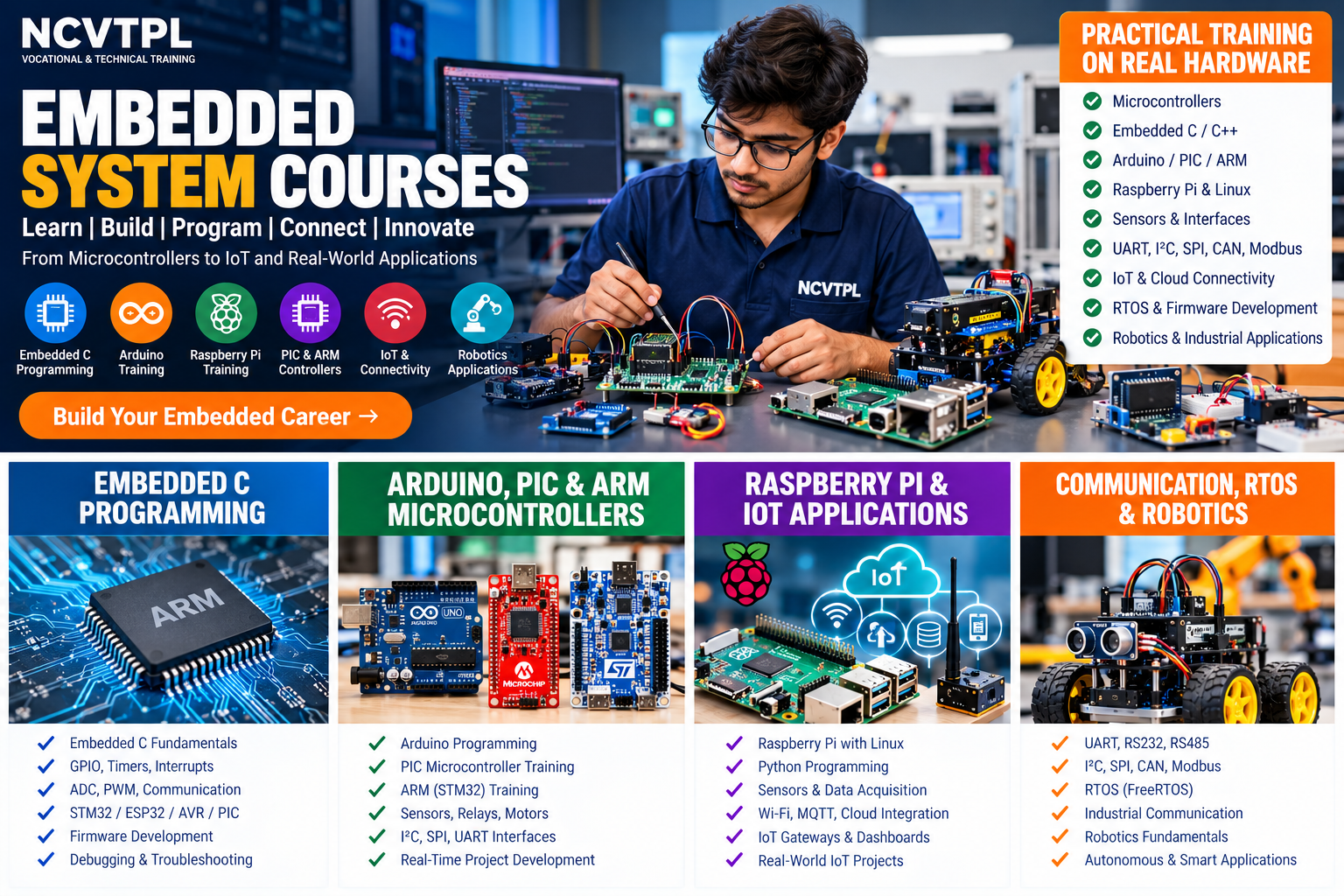
Practical Embedded Training on Real Hardware
Embedded engineering becomes meaningful when programs interact with physical inputs, outputs, sensors, communication buses and real devices.
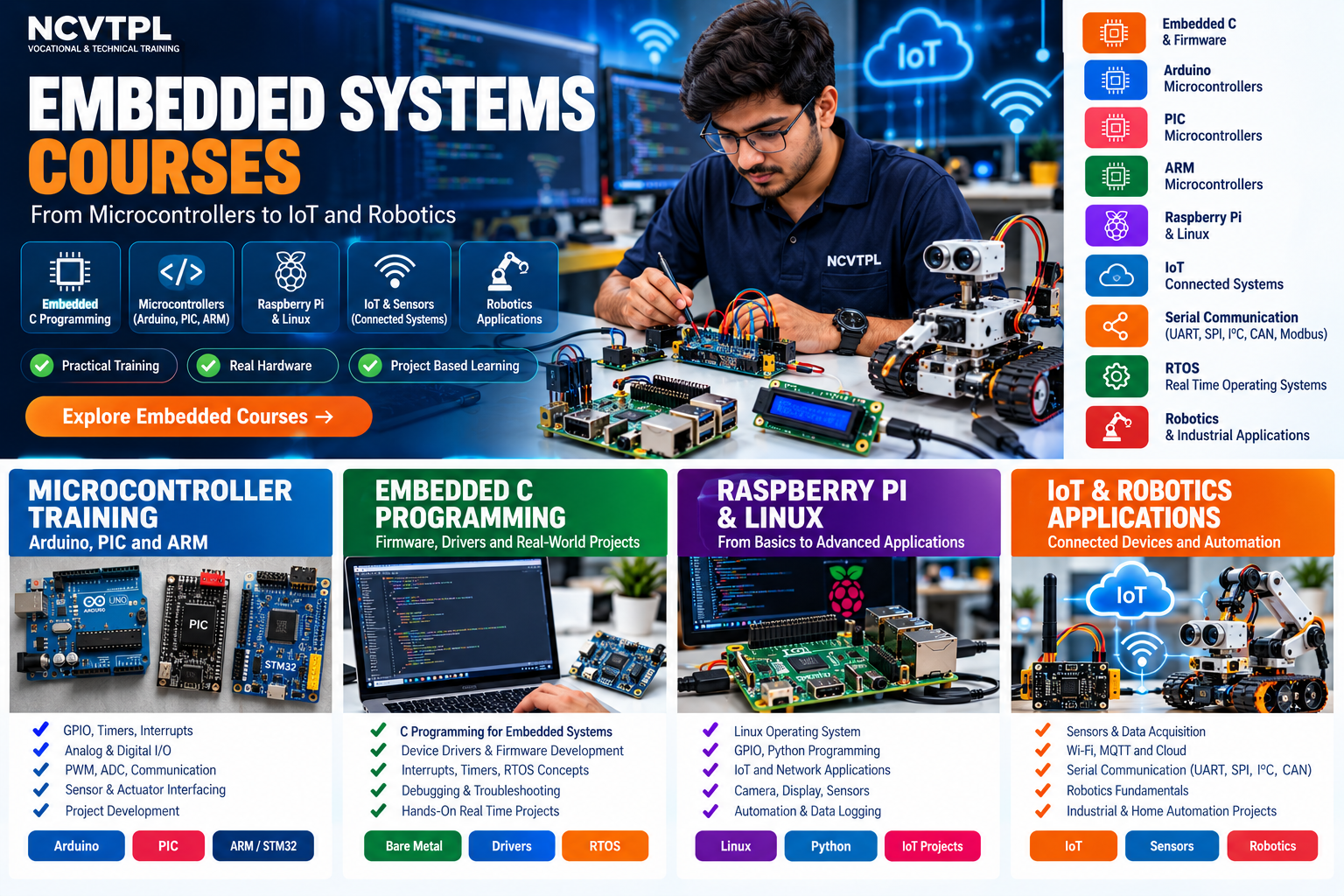
Embedded System Courses & Technology Programs
Choose an individual technology or combine multiple programs into a progressive embedded engineering path.
Advanced C & Embedded C
Develop strong low-level programming skills using pointers, structures, unions, bit operations, memory, registers and hardware-oriented C.
View Advanced C Training →8051, ARM & PIC Microcontrollers
Learn controller architecture, Embedded C, GPIO, timers, interrupts, ADC, PWM and communication interfaces.
View Microcontroller Training →Arduino Micro Controllers
Learn Arduino hardware, Embedded C/C++, digital and analog I/O, PWM, sensors, motors, relays, I²C, SPI and IoT applications.
View Arduino Training →PIC Micro Controllers
Learn PIC16/PIC18, Embedded C, GPIO, timers, interrupts, ADC, PWM, UART, SPI and I²C.
View PIC Training →ARM Micro Controllers
Learn ARM architecture, Cortex-M concepts, Embedded C, GPIO, interrupts, ADC, PWM and serial communication.
View ARM Training →Modern Connected Microcontrollers
Progress into STM32, ESP32, modern peripherals, firmware, connectivity, wireless systems and connected embedded applications.
Explore Advanced Microcontrollers →Raspberry Pi Microcontrollers Training
Learn Raspberry Pi hardware, Linux, Python, GPIO, sensors, serial interfaces, networking, automation and IoT applications.
View Raspberry Pi Training →RTOS – Real Time Operating Systems
Learn tasks, priorities, scheduling, multitasking, semaphores, mutexes, queues, interrupts and real-time application design.
View RTOS Training →Serial Communication & Bus
Learn UART, RS232, RS485, SPI, I²C, CAN, Modbus, frames, addressing, wiring and communication troubleshooting.
View Serial Communication →CAN, CANopen & SAE J1939
Learn CAN physical layer, CAN frames, identifiers, network architecture, CANopen concepts, J1939 PGNs/SPNs and machine communication.
Explore CAN / J1939 Training →IoT & Connected Embedded Systems
Connect sensors and embedded controllers using Wi-Fi, Ethernet, MQTT, gateways, cloud communication and remote monitoring.
Explore IoT Learning Path →Embedded Linux
Develop Linux-based embedded skills involving system operation, GPIO, interfaces, networking, processes and embedded applications.
Explore Embedded Linux →Robotics Fundamentals
Learn robotic structures, motors, drives, encoders, sensors, controllers, end effectors and basic robot programming.
View Robotics Fundamentals →Advanced Robotics
Learn industrial robot programming, kinematics, motion, machine vision, PLC integration, communication and robotic cells.
View Advanced Robotics →Embedded Industrial Automation
Integrate embedded controllers with sensors, drives, industrial communication, PLC systems and machine-control applications.
Explore Industrial Automation →Embedded Vision & Edge AI
Explore camera interfaces, image acquisition, embedded vision, local inference, intelligent sensors and Edge AI concepts.
Explore Advanced Embedded Engineering →Arduino, PIC, ARM & Modern Microcontrollers
Microcontroller training builds the connection between software and electronic hardware. Learners work with processor architecture, registers, peripherals, interrupts, analog signals, communication and real-time control.
Progress From Foundation to Professional Embedded Engineering
Build skills progressively rather than treating each technology as an isolated subject.
Foundation
Electronics, digital systems, C programming, sensors and interfaces.
Microcontrollers
8051, Arduino, PIC, ARM, STM32, peripherals and firmware.
Advanced Embedded
RTOS, communication, CAN, Linux, debugging and system integration.
Connected Intelligence
IoT, robotics, industrial systems, vision and Edge AI.
Raspberry Pi, IoT, Communication & Robotics Applications
Modern embedded systems increasingly connect sensors, machines and intelligent devices through local networks, industrial buses, wireless communication and cloud-connected architectures.
Embedded & Industrial Communication Protocols
Where Embedded Systems Are Used
Industrial Automation
Machine controllers, sensors, motor control and industrial communication.
Automotive Electronics
ECUs, CAN/J1939, sensors, displays and vehicle electronics.
Robotics
Robot controllers, sensors, motors, encoders and intelligent motion.
Internet of Things
Connected sensors, gateways, MQTT, dashboards and remote monitoring.
Consumer Electronics
Smart products, appliances, interfaces and electronic devices.
Instrumentation
Measurement systems, data acquisition, sensors and monitoring equipment.
Energy & Power
Monitoring, controllers, intelligent power systems and energy devices.
Embedded Vision & AI
Cameras, image processing, inspection and intelligent edge devices.
Embedded Systems Career Areas
Who Can Learn Embedded Systems?
Students & Graduates
- Electronics Engineering students
- Electrical Engineering students
- Instrumentation students
- Computer Engineering students
- Embedded Systems students
- Mechatronics students
- Automation students
- Robotics students
- Diploma engineers
- Engineering graduates
Professionals
- Embedded developers
- Firmware developers
- Electronics engineers
- Automation engineers
- IoT developers
- Robotics engineers
- Control engineers
- Automotive electronics engineers
- Service engineers
- Electronics technicians
Embedded System Courses FAQs
What are Embedded System Courses?
Embedded System Courses teach the hardware, software and firmware technologies used to build dedicated computing systems inside machines, electronic products, industrial equipment, vehicles, IoT devices and robotics.
Which programming language is important for embedded systems?
Embedded C is a core programming language for microcontrollers and firmware development. Other languages and environments may also be used depending on the platform and application.
Can beginners learn embedded systems?
Yes. Beginners can start with electronics, C programming and microcontroller fundamentals before progressing into communication, RTOS, Linux and IoT.
Which microcontrollers can I learn?
The NCVT embedded learning ecosystem covers platforms and concepts including 8051, Arduino, PIC, ARM, STM32 and ESP32.
Is Arduino training included?
Yes. A dedicated Arduino program covers C/C++, digital and analog I/O, sensors, actuators, PWM, communication and IoT applications.
Is Raspberry Pi included?
Yes. Raspberry Pi training includes hardware, Linux, Python, GPIO, sensors, communication, networking and IoT applications.
Does NCVT provide RTOS training?
Yes. RTOS training covers real-time concepts, tasks, scheduling, multitasking, semaphores, mutexes, queues, interrupts and embedded application development.
Which communication protocols are covered?
Embedded communication topics include UART, RS232, RS485, SPI, I²C, CAN, Modbus and advanced CAN-based technologies such as CANopen and J1939.
Does the embedded pathway include IoT?
Yes. IoT topics connect sensors, embedded controllers, Wi-Fi, networking, MQTT, gateways and remote data communication.
Is robotics included?
Yes. Learners can study robotics fundamentals and progress toward industrial robot programming, motion, machine vision and PLC integration.
Does NCVT offer a complete Embedded Engineer program?
Yes. The NCVT Certified Embedded Systems Engineer pathway integrates electronics, Embedded C, microcontrollers, firmware, RTOS, Embedded Linux, communication, IoT, robotics and advanced embedded technologies.
Build From Microcontrollers to Complete Embedded Systems
Develop practical skills in Embedded C, Arduino, PIC, ARM, Raspberry Pi, RTOS, communication, CAN/J1939, IoT and robotics with NCVTPL.
Get Embedded Systems Course Guidance →